1 — The concrete scene
A solar array is restrained for launch, then must release, move, latch and be confirmed. One blocked step can remove much of the available power.
The key point is never to isolate this subject from the rest of the spacecraft. A local change often moves mass, power, heat, data, software, testing or risk elsewhere in the system.
2 — Essential words, explained before using them
Before calculating, we define every word that will be used next. The goal is for the symbol to come after the idea, never before it.
- Mechanism
- Parts performing movement or locking.
- Actuator
- Converts energy into motion.
- Deployment
- Transition from compact to operational configuration.
- Torque
- Rotational effect of force, in N·m.
- Clearance
- Gap between parts affecting jamming and accuracy.
- Single point
- One failure is enough to lose the function.
3 — See the architecture before calculating
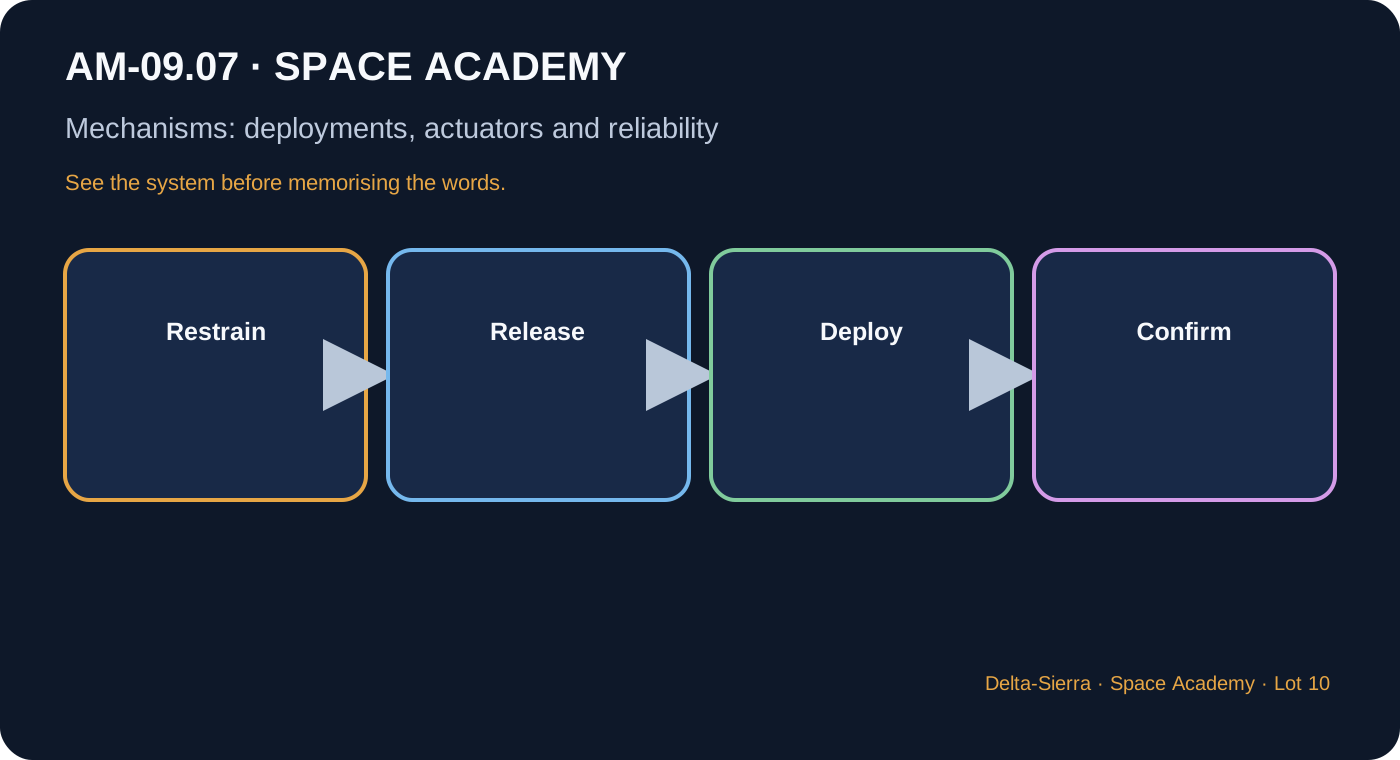
Restraint
Survive launch without unwanted motion.
Release
Sometimes irreversible action.
Motion
Spring, motor or actuator provides torque.
Confirmation
Sensor proves position is reached.
4 — Formulas, only when they answer a question
A formula is useful only if we know which question it answers, what every symbol means, and which units must be used.
How to read it : tau equals force times lever arm
For perpendicular force; real torque depends on geometry and friction.
5 — What units and margins mean
N for force, N·m for torque, degrees or radians for angle, cycles for life under a defined profile.
6 — Three concrete demonstrations, calculated step by step
Hinge
30 N at 0.20 m.
τ=30×0.20
=6 N·m
Resistance 4 N·m → excess 2 N·m
Unconfirmed command
Open command sent, end switch inactive.
Command sent ≠ position proven
Check current and time
Do not continue hazardous sequence.
Cycles
200 test cycles for 20 mission cycles.
Ratio=200/20
=10×
Load profile must remain representative.
7 — Deepening: what the simplified diagram hides
Tribology
Vacuum, lubrication and materials change friction and wear.
Temperature
Clearances and resisting torque change with expansion.
One-time deployment
Simplicity, margin and testing compensate for limited statistics.
Sensors
End switches, encoders and motor current give different evidence.
System risk
A mechanism adds capability but also complexity and sometimes a single point.
8 — Application to an Earth-Mars spacecraft
On an Earth-Mars transit, long duration turns a small weakness into cumulative risk: ageing, drift, consumption, cycles and maintenance become as important as nominal performance.
Communication delay forces the vehicle and possibly the crew to diagnose and reconfigure locally. Design must therefore remain observable, understandable and testable in degraded modes.
9 — Reference dossier: what a real project must still consider
This section deliberately goes beyond the introductory calculation. It connects the concept to interfaces, failures, testing, duration and maintenance so the lesson can serve as a reference chapter rather than a revision card.
A mechanism turns command into physical motion
Motors, gears, springs, hinges, latches, cables, bearings and sensors can form a spacecraft mechanism. It must work after launch vibration, vacuum, extreme temperature and sometimes months of storage. One-shot deployments gain confidence from simplicity, margins, material control and representative testing rather than in-flight statistics.
Tribology changes in vacuum and dust
Moving surfaces depend on friction, wear and lubrication. Vacuum can make terrestrial lubricants unsuitable, while Mars dust adds abrasion and contamination. Material pairs, coatings, compatible lubricants, clearances, cleaning and inspection therefore matter.
Clearance, thermal expansion and resisting torque
A joint that moves at room temperature can bind when cold or become loose when hot. Analysis covers manufacturing tolerances, temperature, wear and alignment. Actuators need enough torque margin without damaging hardware at stops.
Deployment can be irreversible
A solar-array or antenna deployment may happen only once. Designers must plan for false sensors, motor overcurrent and partial deployment, and recovery logic is part of the mechanism system, not merely software.
Multiple position clues improve diagnosis
Limit switches, encoders, motor current and cameras each provide different evidence. Each can be ambiguous on its own, so combining them improves diagnosis, especially when a Mars crew must decide whether physical intervention is safe.
Mechanisms can create single-point failures
NASA notes that mechanisms add capability and complexity and can introduce single-point-failure risk. System design should ask whether a minimum mission is possible without the mechanism, whether independent paths exist or whether a fixed architecture can eliminate motion entirely.
Repairability on Mars
Surface equipment may be repairable, increasing the value of accessible fasteners, standard parts, lifting tools and documentation. EVA dexterity and contamination still constrain what can be done outside, so repair tasks should be allocated between external work and pressurised workshops.
10 — Common traps and bad intuitions
- Confusing command and actual motion.
- Ignoring temperature and clearances.
- Adding mechanism without addressing single-point risk.
11 — Guided exercises
Question : What question comes before choosing hardware?
Question : Why is a nominal result insufficient?
12 — What to remember
- Explain the topic in simple words before symbols.
- Connect at least four interfaces with other subsystems.
- Redo the three numerical examples without reasoning gaps.
- Identify at least three limits or failure modes absent from the ideal calculation.
13 — NASA sources for further study
Primary institutional sources used to check the lesson structure. Teaching-number examples are identified as such.