1 — The concrete scene
At low altitude, engines, ground and landing gear interact directly. A small residual speed can still carry substantial energy at high mass. Jets can erode regolith, eject particles, excavate material and disturb sensors or nearby infrastructure. Terminal control must therefore manage vertical speed, lateral speed, attitude, height, thrust and ground state through contact and safe engine shutdown.
The first discipline is to separate what physics imposes from what architecture chooses. For terminal, panaches, régolithe, train, a relationship may be certain while the numerical value still depends on mission, mass, altitude, weather or design margin. This prevents a teaching example from becoming a universal rule.
2 — Essential vocabulary
Each term is defined before the formula so the symbol follows the idea rather than replacing it.
- EDL
- Entry, descent and landing: the chain transforming an arriving vehicle into a landed vehicle.
- State
- Estimated variables such as position, velocity, attitude and other useful quantities.
- Margin
- Deliberate separation between demonstrated capability and mission need.
- Dispersion
- Spread of outcomes caused by uncertainty and variation.
- Mode
- System configuration during a given phase.
- Envelope
- Domain of conditions in which a function is authorised.
3 — See the chain before calculating
A chain of states
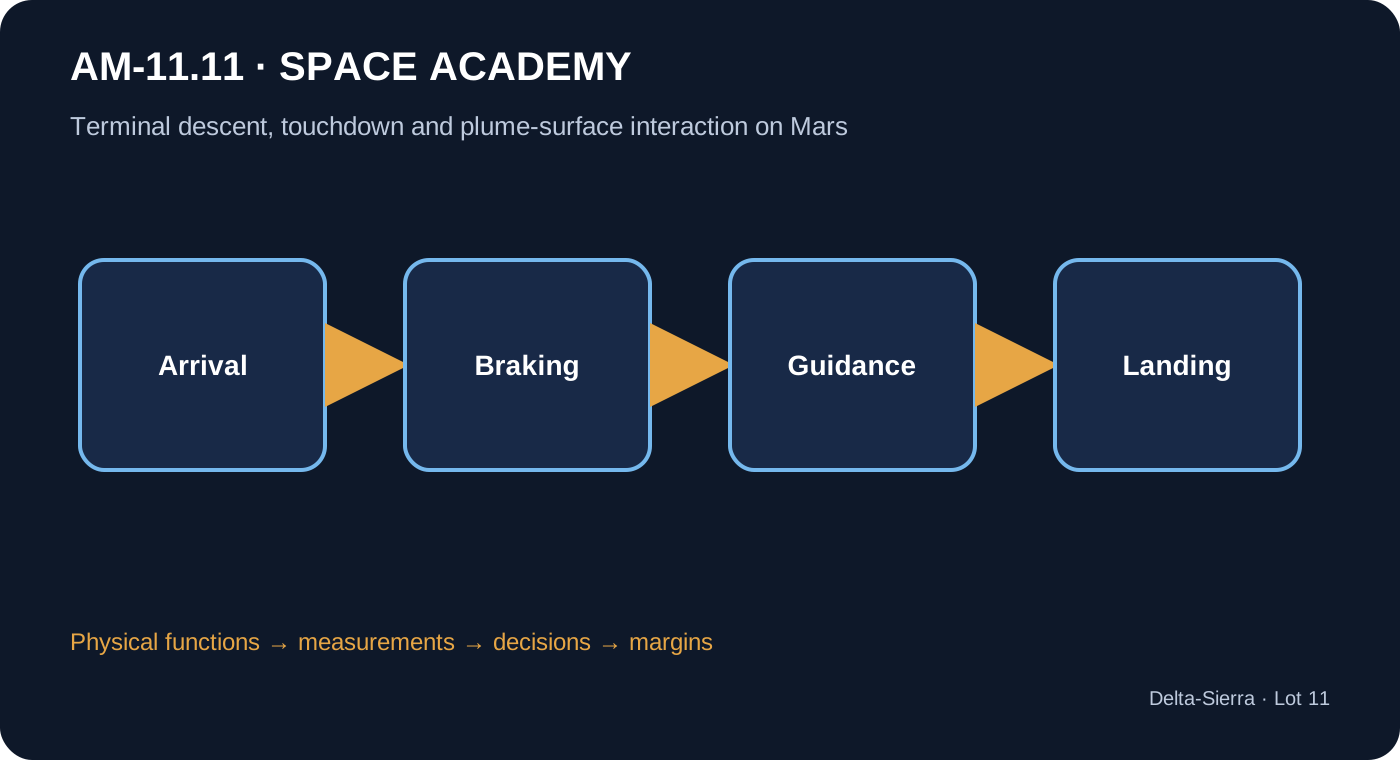
A second discipline is to follow interfaces. During EDL, thermal conditions affect structure, structure affects mass, mass affects deceleration, navigation affects guidance, guidance consumes aerodynamic or propulsive margin, and landing immediately sets conditions for surface operations. A local value is therefore never isolated.
Transitions and conditions
Chronology is also an engineering variable. An event may be correct by itself but dangerous if it occurs too early, too late, with a sensor not yet valid or an actuator outside its envelope. Engineers therefore verify entry conditions for each mode, exit criteria and degraded transitions.
4 — The formula and every symbol
Read aloud : residual kinetic energy equals one half m v squared; average absorption force can be estimated as energy divided by stopping distance d.
A symbol only has meaning with its unit and convention. Metres, seconds, kilograms, newtons, pascals and joules are checked before entering an operation.
5 — Three detailed calculations
1. 30 t at 1 m/s
First write the data and units, then replace each symbol by its value. The operation is shown before interpretation.
0.5×30,000×1² = 15 kJ
2. 30 t at 2 m/s
First write the data and units, then replace each symbol by its value. The operation is shown before interpretation.
0.5×30,000×2² = 60 kJ: doubling speed quadruples energy
3. Absorption over 0.5 m
First write the data and units, then replace each symbol by its value. The operation is shown before interpretation.
60,000/0.5 = 120 kN; Mars weight of 30 t ≈ 111.3 kN
6 — What the simplified model hides
The first discipline is to separate what physics imposes from what architecture chooses. For terminal, panaches, régolithe, train, a relationship may be certain while the numerical value still depends on mission, mass, altitude, weather or design margin. This prevents a teaching example from becoming a universal rule.
A second discipline is to follow interfaces. During EDL, thermal conditions affect structure, structure affects mass, mass affects deceleration, navigation affects guidance, guidance consumes aerodynamic or propulsive margin, and landing immediately sets conditions for surface operations. A local value is therefore never isolated.
Chronology is also an engineering variable. An event may be correct by itself but dangerous if it occurs too early, too late, with a sensor not yet valid or an actuator outside its envelope. Engineers therefore verify entry conditions for each mode, exit criteria and degraded transitions.
Finally, carrying crew does not change fundamental equations, but it changes risk tolerance, mass, redundancy, abort logic, physiological constraints and qualification. Robotic heritage is therefore experimental evidence, not an automatically transferable human architecture.
7 — Uncertainty, margins and dispersions
A nominal trajectory is only a reference centre. Density, actual mass, centre of gravity, navigation error, actuation delays and propulsion performance create a cloud of cases. Monte Carlo analyses, testing and margin seek to show that this cloud remains within acceptable limits.
An altitude, speed or duration on an infographic must therefore never be read as a mandatory event for every Mars vehicle.
8 — Credible failures and degraded modes
- inconsistent or unavailable sensor;
- actuator or engine not delivering the expected command;
- atmosphere or surface outside nominal assumptions;
- unconfirmed mode transition;
- insufficient margin after several deviations combine.
Safety requires detection, isolation, decision and recovery fast enough that the next phase remains possible.
9 — From Perseverance to a human vehicle
Perseverance is major experimental heritage: guided entry, supersonic parachute, terrain-relative navigation, powered descent and sky crane were autonomously sequenced. But a human-class mass of several tens of tonnes changes dimensions, loads and candidate technologies. The comparison teaches functions and scale gaps, not a trajectory to copy.
Finally, carrying crew does not change fundamental equations, but it changes risk tolerance, mass, redundancy, abort logic, physiological constraints and qualification. Robotic heritage is therefore experimental evidence, not an automatically transferable human architecture.
10 — How it is demonstrated
Credible EDL combines analytical calculations, computational aerodynamics and heating, material tests, wind tunnels, parachute or engine tests, sensor benches, hardware-in-the-loop simulation, navigation campaigns, integrated tests and flight demonstrations. Each item of evidence has a boundary: a material test does not validate the complete vehicle.
Maturity must be assessed at system level and in the relevant environment, distinguishing what has flown on Mars, what has flown elsewhere and what remains demonstrated only on the ground or in simulation.
11 — Understanding exercises
Question 1 : Which course value is a physical relation and which is only a scenario?
Question 2 : What must be revisited if mass rises by 20%?
12 — What to remember
- EDL is a coupled chain, not a collection of gadgets.
- Every number needs a unit, boundary and source or must be labelled as a scenario.
- Robotic heritage is essential, but human scaling is a real engineering problem.
13 — Primary institutional sources
These references constrain doctrine and orders of magnitude; they do not turn teaching scenarios into an official architecture.
- NASA 2023 - Entry, Descent and Landing State of the Union and Future Technologies
- NASA - Human Mars Entry, Descent and Landing Architecture Study Overview
- NASA - Advancing Supersonic Retropropulsion Using Mars-Relevant Flight Data
- NASA - Entry, Descent and Landing Guidance and Control Approaches
- NASA - Planetary Entry Vehicles Quick Reference Guide
- JPL - Mars 2020 Perseverance Landing Press Kit